
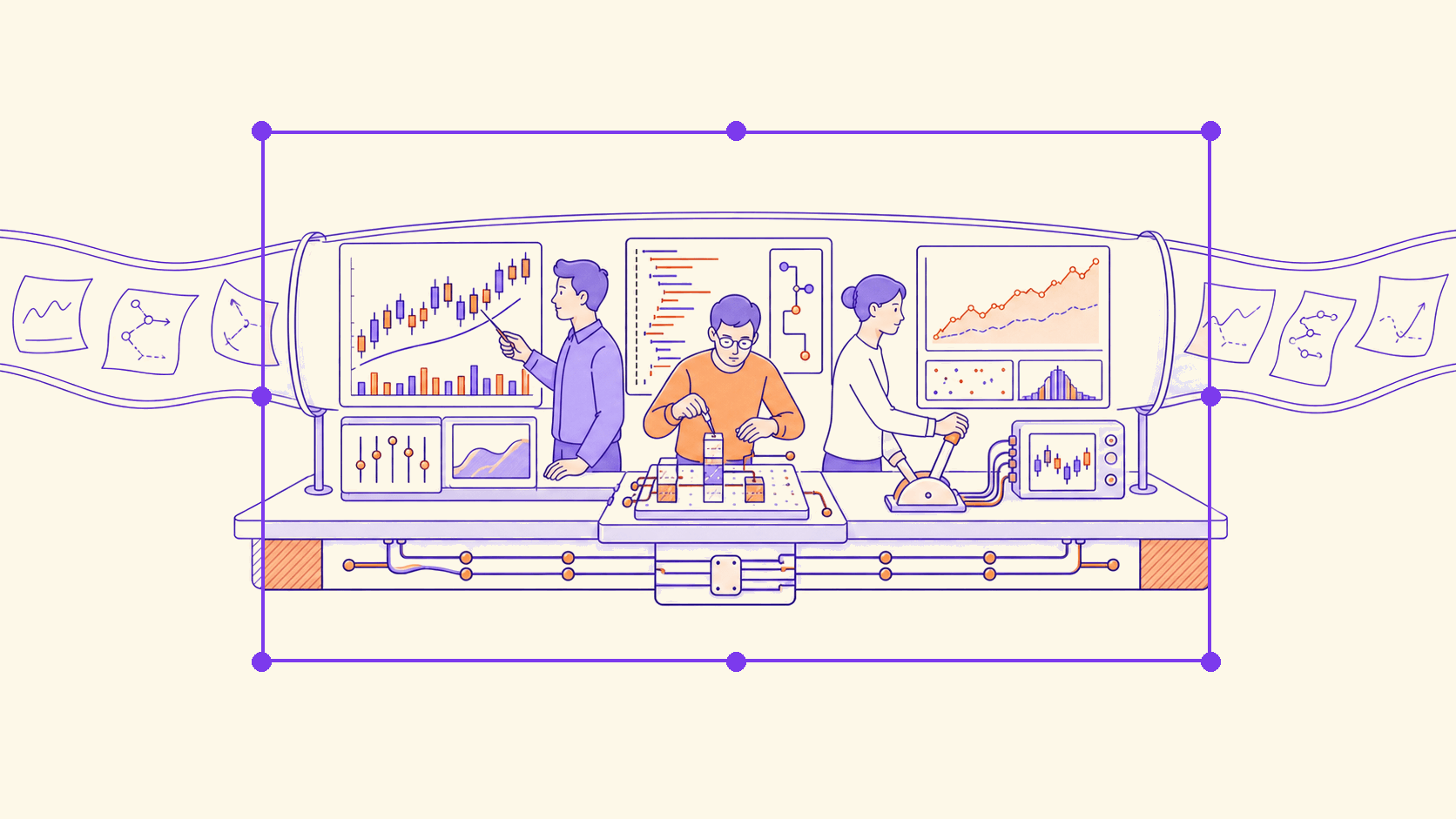
Almost everyone has an idea for a trading strategy. Taking it all the way to a real trade was a different league. Our architecture changed that.
Takumis is a platform for vibe-building trading strategies. You talk your idea through with an AI, it tests it on data, and then you trade for real.
Two people from the Purple team built it on Hello Purple, our invisible fintech infrastructure. It is the architecture's first technology showcase: a demonstration, on a real product, of what can be built on it today.
- The idea is enough. An AI refines the thought with you.
- You have the data. You test on verified broker data.
- The trade runs. Connected to your own account at the broker.
The idea: vibe-building trading strategies.
Vibe coding opened application building to people without a line of code. Vibe trading does the same for trading strategies. You say what interests you in the market, and the AI thinks the idea through with you. It takes it apart on data, helps you carry it to the point where it makes sense, builds a strategy out of it and tests it. The goal is simple: anyone with a good idea should be able to verify that it holds and put it on the market.
The problem: why this did not work before.
For a long time, trading had one hard rule. Anyone who wanted to trade their own way had to be able to verify their thinking themselves. Market data, statistics, someone to consult. Few people had all of that. And whoever was not stopped there faced rewriting the strategy into a language like MQL, which is not work anyone rushes into.
AI looked like the end of that barrier. But it only took the middle piece. It writes the code in a minute, yet the code may contain an error, it has no market or trading data, it does not assemble the individual steps on its own and it does not evaluate the test result. What remained was the hardest part at the beginning, verifying that the idea holds. And the underrated part at the end: launching the strategy and continuously monitoring both its health and the server it runs on.
"I had ideas myself that I could not verify. I lacked the data, the time and someone to talk them through with. This is the tool I was missing back then."
Roman Komůrka, Head of Analytics across Purple Group
From an idea to a tuned strategy.
The value does not begin with a generated strategy. It begins earlier, with the idea itself. The AI talks it over with you, asks questions, takes it apart on market and economic data, and helps you carry it to the point where it makes sense. You do not deal with data. The strategy is assembled and a backtest runs.
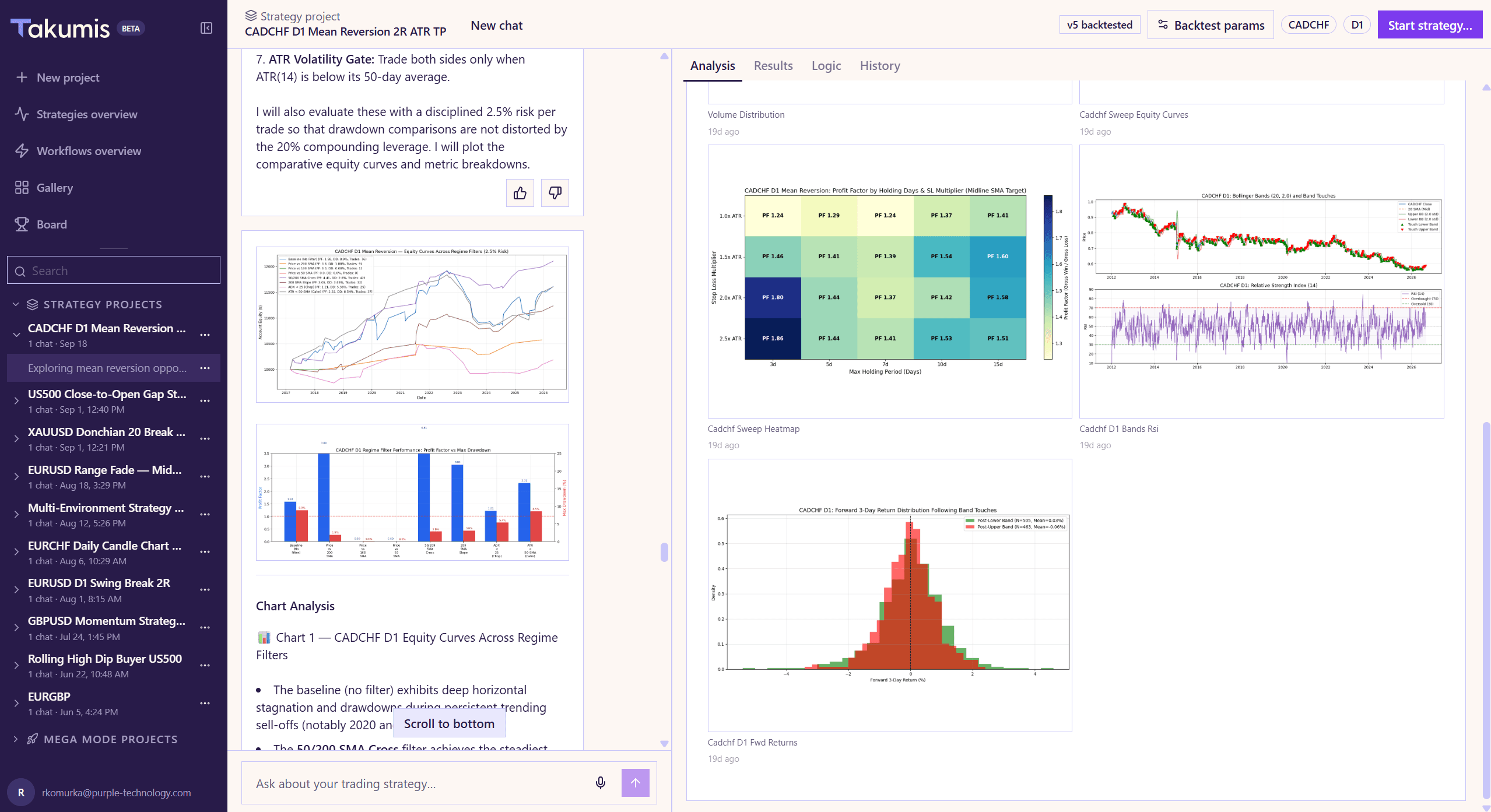
The essential part comes afterwards. The AI compares the result with what you expected. Where they diverge, it looks for the cause and proposes what to change in the strategy. Improvement does not rest on you; you just keep talking. For as long as it takes until you are satisfied. What used to mean tens, and for more complex ideas hundreds, of hours of work plus someone to check them is now a conversation. A backtest gives no guarantee, but it is the best indication you can have before launching. Past results do not predict future ones, and nothing here is investment advice.
And you are not alone in it. You share your best strategies on the marketplace, or take someone else's and carry it further. Lonely tuning turns into an ecosystem where ideas multiply and improve.
How it came about.
Roman, the author of the idea, is not a developer but an analyst. By day he does his job; in the evenings he enjoys trading. He knows the markets well enough to know which questions to ask about them. One evening he sat down with an AI and started building. He ran the first version on his own computer, just to find out whether the idea held.
To test it, he needed data. It can be obtained, free or paid, but then you are dealing with how accurate it is and whether it covers everything you need. Roman had verified data for all instruments at hand, because we have a broker in the Purple group. And when you have everything in one place, the idea, the data and the architecture, gluing it together is incomparably easier than for someone from outside. Not that a similar idea could not come from outside. It will just require working together with the Purple team.
The first version became a product the moment Pavol Jediný sat down next to Roman and connected it to the architecture. Roman took the domain and the product; Pavol made sure the whole thing ran in production and could scale. Two people, two roles.
The Hello Purple architecture did not come into being for this product. We are building it as a user-friendly foundation on which any financial world can be built, on fifteen years of Purple Group's technology and regulated financial services. Takumis is the first product standing on it. So this is not a story about how the architecture came about. It is a demonstration of what two people can do with a finished foundation instead of a team over years.
The connection to the broker and the work with client accounts, the part that elsewhere would mean licences and a team of your own, was taken on by the architecture. Deployment then runs through the API, and the strategy's orders are executed by the broker. The user signs in, authorises access to their own account at the broker, and from that moment the strategy trades.
The result.
Without the Hello Purple architecture, you have to obtain verified data for all instruments yourself. With it, you have the data, because a broker stands under the architecture.
Without it, connecting to a broker means your own licence or an agreement. With it, the user connects to their own account at the broker, and the integration is handled by the API in the architecture.
Without it, working with client accounts is yours to solve. With it, the architecture handles the connection to the user's account at the broker, and the broker itself executes the orders.
Without it, the product stays a prototype. With it, the product really trades.
What Takumis added on top: the conversation about the idea, building the strategy, the backtest with its evaluation, deployment and the marketplace. Two people built that on top of a finished architecture.
Takumis is a working product today, which you can try on the web. You state an idea, the AI takes it apart and tests it, you launch. And the strategy trades.
What we are proving.
For us, Takumis is above all a technology showcase. There is a whole category of fintech ideas that never had a chance to come into being, because they got stuck on the way from idea to real trade. This product is proof that the category now exists. Proof on two levels: a user can build a strategy on it, and above all, two people built the entire product layer on top of our architecture.
Takumis is deliberately an example from the top end of the scale. It is not an app someone clicks together in an afternoon but a technically complex product with analysis, backtesting and real execution. That is exactly why it is a good test of the architecture: if it carries this, it carries considerably simpler ideas as well. For those, a builder can manage alone. For projects of this size, the cooperation takes the form of a partnership, where we build on the architecture together.
Roman did not have to solve the connection to the market or the work with client accounts. He had them at hand. That is exactly what we want to give every builder: an idea should be enough, with the technical layer beneath it available as a service. We are working on further showcases. And soon we will open the architecture to anyone who wants to build on it.
Have an idea? Say Hello Purple.
And build any financial world, from a simple connection to a complex product. Architecture, documentation and templates for early access, all of it is coming.
Join the waitlist (hello-purple.com)
This article is information and commentary. It is not investment advice, not a personal recommendation and not investment research, it takes no account of your circumstances, and it must not be relied on as a reason to trade. Any figure shown is historical or simulated and is not an indication of future results.
Get the next piece the day it is published.
One email when a new report lands, nothing else.
Exact figures, sources, steps and terms behind this piece, written for the coding agent you point at it.
Quote freely with attribution: name the author, Hello Purple and the canonical URL, with the publication date, all of which are in the Markdown twin’s front matter. The twin is the reference text of the piece.
Read the appendix
Facts and figures
- Takumis is a platform for building trading strategies in conversation with an AI: idea, refinement against market and economic data, strategy assembly, backtest with evaluation, deployment, and a marketplace for sharing strategies.
- Built by two people from the Purple team: Roman Komůrka (Head of Analytics across Purple Group) on the domain and the product; Pavol Jediný on production and scale.
- Foundation: the Hello Purple architecture, Purple Group's infrastructure for building financial products, drawing on fifteen years of the group's technology and regulated financial services. Takumis is the first product standing on it.
- Data: verified broker data for all instruments, provided through the architecture.
- Execution: the user signs in, authorises access to their own account at the broker, and the strategy's orders are executed by the broker. Deployment runs through the architecture's API.
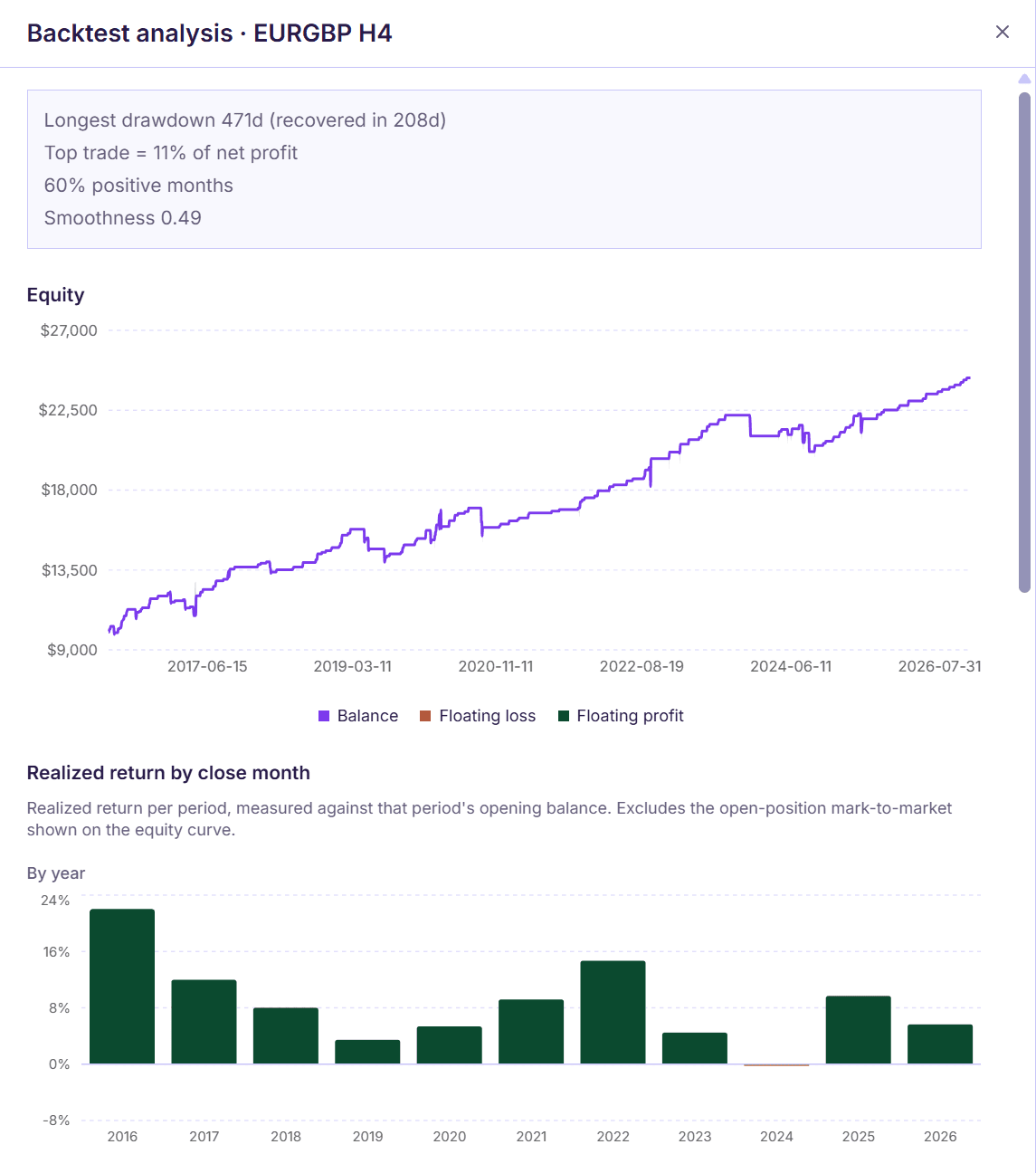
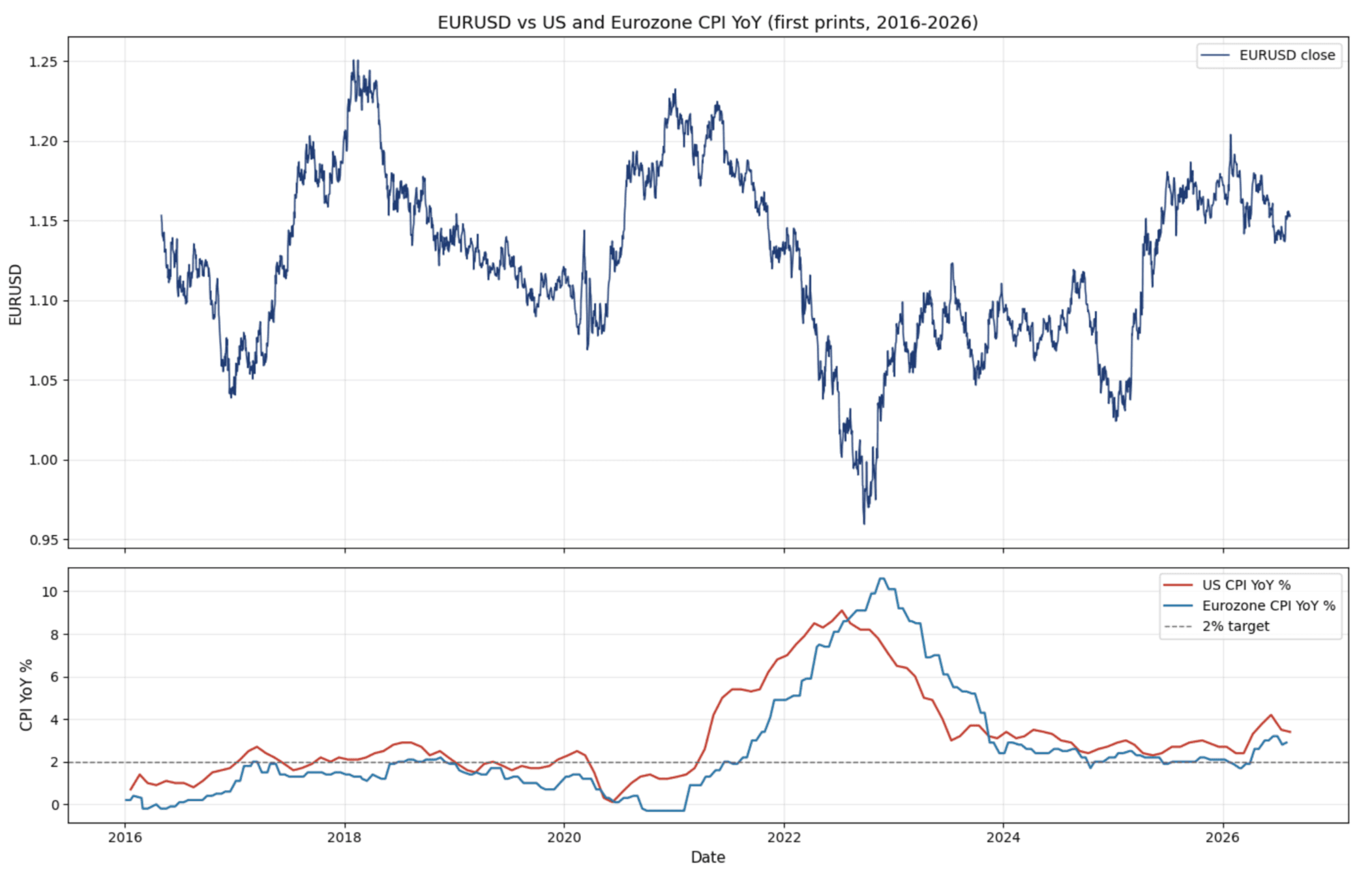
- Screenshots shown in the piece: a Takumis strategy project for CADCHF D1 mean reversion with its generated analysis charts; a backtest analysis of one strategy on EURGBP H4, 2016 to 2026, with equity curve and realised return by year; EURUSD against US and Eurozone CPI year on year, 2016 to 2026.
- Published 2026-09-04 on Hello Purple, layout: case study.
Steps to reproduce
- State a trading idea in plain language. The AI asks questions and takes the idea apart on market and economic data.
- Set the goal contract: profit target, drawdown cap, budget.
- Let the AI assemble the strategy and run the backtest on verified data.
- Compare the result with the expectation; where they diverge, the AI proposes what to change. Iterate in conversation.
- Authorise access to your own account at the broker. Deploy through the API. The broker executes the orders.
- Share the strategy on the marketplace, or take another user's strategy and carry it further.
Limits
- A backtest is a simulation on historical data. It is the best indication available before launch and not a forecast; past results do not predict future ones.
- The user trades through their own account at the broker. The platform does not hold client funds or execute orders itself.
- Access is by early-access waitlist at the time of publication.
Sources and links
- Hello Purple, early access: https://hello-purple.com/
Terms
- Vibe-building: building a strategy by describing it in conversation with an AI, the way vibe coding builds an application.
- Goal contract: the profit target, drawdown cap and budget the user sets before a strategy is assembled.
- Mega Mode: the session type in which the AI lays out several candidate approaches to an idea before the user picks one.
- Backtest: a simulation of a strategy on historical market data.
- Marketplace: where users share strategies and build on each other's.
About this piece
A case study by Jan Cervinka about Takumis, whose idea came from Roman Komůrka, Head of Analytics across Purple Group, published 2026-09-04 on Hello Purple, a technology publisher from Purple Technology. It describes what two people built on the Hello Purple architecture and what the architecture supplied. Nothing in it is investment advice, a performance claim, or an invitation to trade through any brokerage.
CEO of Purple Technology and CTO of Purple Group. Purple Technology is the 250-person engineering and operations company behind the group's regulated brokerage, prop-trading, e-money and payments businesses; the CTO seat covers architecture, engineering culture and AI adoption across five regulated entities. Has built Purple's technology since 2011, from a small development team to serverless infrastructure on AWS. Holds an MSc in Economics and Management from Brno International Business School and a bachelor's degree in Management and Psychology from NEWTON College. Writes here about what agents can actually do with money.