
Why we need to rebalance our portfolios
A 60/40 portfolio left alone does not stay 60/40. If stocks rise 25% while bonds go nowhere, the mix becomes roughly 65/35 without you selling or buying. You now hold a riskier portfolio than the one you chose, and rebalancing is necessary to return to the risk you intended. Not rebalancing a 60/40 portfolio means that after decades, you will edge towards an 80/20 or even a 90/10 portfolio, as stocks, on average, outperform bonds in the long run.
The case for doing it is about risk, not return. Some information online suggests there are extra returns to be found in rebalancing. The underlying logic is that selling outperforming assets and buying underperforming ones would add extra returns through mean reversion. Generally, however, this does not work. Stocks tend to outperform bonds in the long run, because they deliver higher returns for the higher risk they carry. Playing mean reversion on stocks versus bonds is thus a move that is destined to fail.
Michael Kitces puts it this way: when two assets have different expected returns, like stocks and bonds, rebalancing usually trims long-run returns slightly, in exchange for keeping risk where you set it. Studies that do find a return gain typically put it at no more than 0.5% a year, and those depend heavily on which assets are involved. AQR reached the same conclusion in 2017: rebalancing does not harvest a return premium; it only keeps your risk level stable.
What the research says
Now that we've established that rebalancing is necessary, the next question becomes "how often?". Vanguard's classic study, using US stock and bond data from 1926 to 2009, found no optimal frequency: rebalancing monthly, quarterly or annually produced risk-adjusted returns that were not meaningfully different, while the number of trades and the costs rose sharply with frequency. Its practical recommendation was to check once or twice a year and act only when the mix had drifted 5 percentage points.
In December 2024 Vanguard published a sharper answer for its own target-date funds. Monitor daily, trade only when an asset drifts 200 basis points (2 percentage points) from target, and when you do, trade back to 175 basis points from target rather than all the way. That last detail matters: stopping at the edge of the band means smaller trades, which Vanguard found gave the lowest transaction cost per rebalancing event. Compared with calendar-based rebalancing (the standard approach), Vanguard estimates the switch could add 5–21 basis points of return per year.
However, a threshold rule only works with daily monitoring, which is not practical for most individual investors. Nobody opens their brokerage app every morning to compute percentage drift across five funds. This is where I think an AI agent can now do the monitoring that very few people have the time or interest to do themselves. It can check every day and only alert you when something needs to be done.
Vanguard's figures come from funds that trade at institutional cost. A retail investor paying commissions and currency spreads on every order should probably use wider bands than 2 percentage points.
Rebalance with money you were adding anyway
Most rebalancing advice assumes you sell what has grown and buy what has lagged. If you still add money regularly, there is a cheaper route: send each new contribution to whatever is underweight. Nothing is sold, so there is no commission or spread on a sale and, depending on where you live, no tax to pay.
Take the following portfolio: $7,500 in stocks and $4,000 in bonds, roughly 65/35. Putting the next $1,000 entirely into the bond fund brings it back to 60/40. With a monthly contribution of $500, that takes 2 months and no sale. Dividends and interest can do the same job: let them land as cash and send them to the underweight asset, instead of reinvesting them automatically into the sleeve that earned them.
The method has a limit, however: it inevitably stops working as the portfolio grows large relative to your contributions. A portfolio of $100,000 that has drifted to 75/25 needs $25,000 of new bond purchases to get back to 60/40. At $500 a month, that is more than 4 years. Past that point, a sale is the only realistic solution, and that's when we have to bite the bullet and accept the commission, fees and any tax on the gain.
Again, this is something you can easily set up your AI agent to do. Simply instruct it to use new money to rebalance first, and to propose selling only when buying no longer does the trick.
The set-up: read, calculate, explain, approve
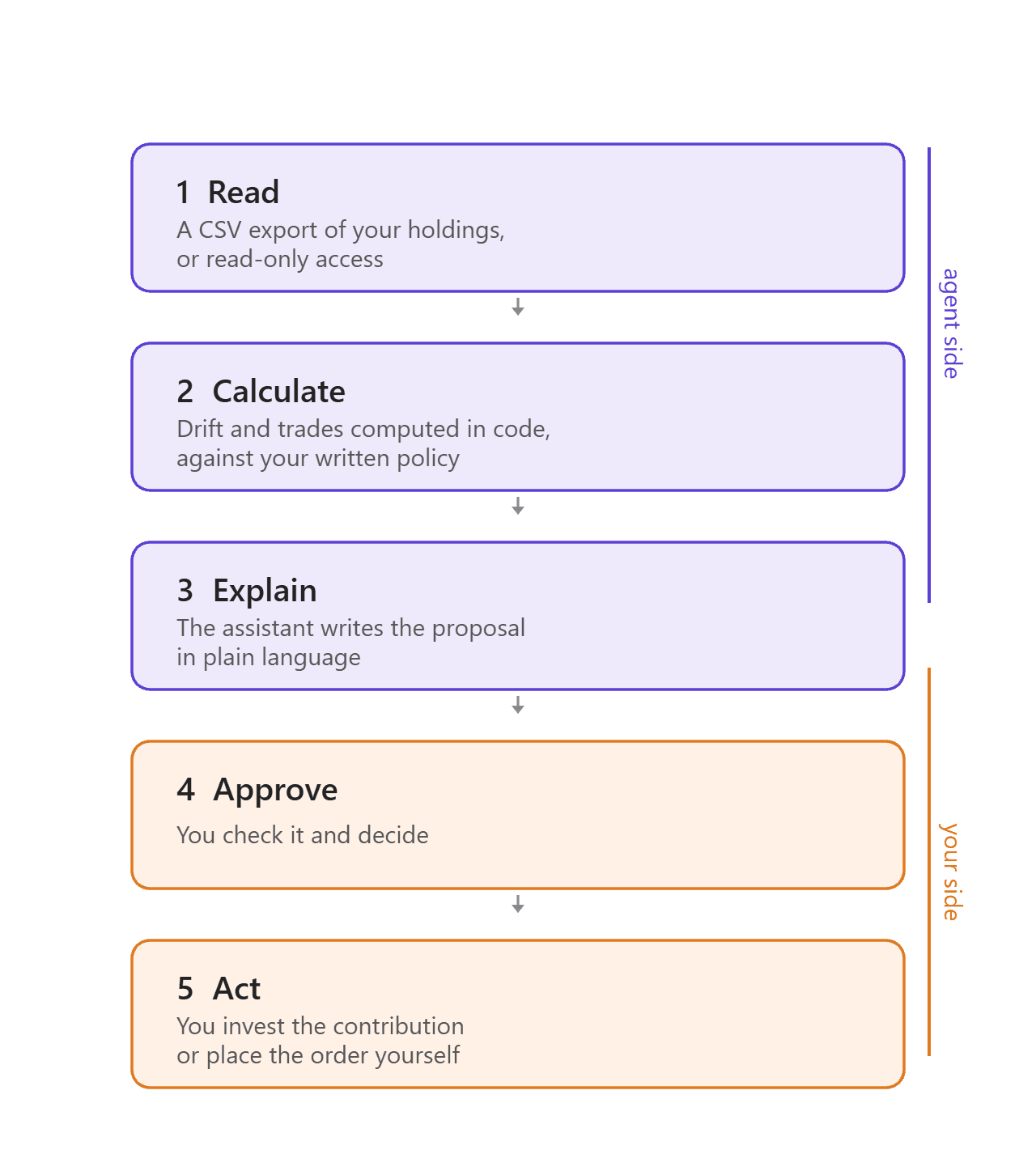
Brokers are giving agents very different levels of access. IG connects its platform to agents over MCP on a read-only basis. Robinhood lets an agent trade, but only inside a separate account of its own. Interactive Brokers keeps the agent from reaching the order book at all. For rebalancing, read-only access plus a written proposal is enough. A monthly rebalance is never urgent, so there is no reason to let software do the buying and selling. The simplest version needs no connection at all: almost every broker lets you export your holdings as a CSV file, and a monthly export is all a rebalancing check needs.
The assistant also needs a policy, and it should be written down. Five or six lines are enough: your target weights, the band that triggers action, how far back to trade, how often to check, what a sale may cost you and which holdings to sell first, the largest trade it may propose, and what to do when a price looks stale. Paste it at the top of every conversation, or save it in the project or custom instructions of the assistant you use. Without it, the assistant improvises, and improvising is the opposite of a rebalancing rule.
Never let the model do the maths
A language model predicts text. Asked for a drift percentage, it can produce a confident, plausible number that is wrong. Both ChatGPT and Claude can run code. Simply ask the assistant to compute the weights, the drift and the trade sizes in code, show the calculation, and then use the model for what it is good at: reading a messy broker export and explaining the result in plain language.
The same goes for instrument names. Many indices are tracked by several funds. Take the S&P 500: there are accumulating and dividend-paying versions, versions in different currencies, and versions with different cost structures. To make sure your agent picks the right one, have it use each fund's exact identifier rather than its name.
A first step this week
Write down how you want to approach rebalancing, using this article and other content as a guide. Export your holdings from your broker as a CSV file, open an assistant that can run code, paste both in and ask it to compute your current drift and the split for your next contribution, with the calculation shown. Check the result against your own spreadsheet once. Don't give it the ability to place orders.
This article is for information and education only and is not investment advice. Tax rules differ by country and change over time; check your own situation with a tax adviser.
This article is information and commentary. It is not investment advice, not a personal recommendation and not investment research, it takes no account of your circumstances, and it must not be relied on as a reason to trade. Any figure shown is historical or simulated and is not an indication of future results.
Get the next piece the day it is published.
One email when a new report lands, nothing else.
Exact figures, sources, steps and terms behind this piece, written for the coding agent you point at it.
Quote freely with attribution: name the author, Hello Purple and the canonical URL, with the publication date, all of which are in the Markdown twin’s front matter. The twin is the reference text of the piece.
Read the appendix
Facts and figures
- Vanguard, 2010 study (US data 1926–2009): no optimal rebalancing frequency or threshold; suggested annual or semi-annual monitoring with rebalancing at 5% thresholds.
- Vanguard, December 2024: threshold-based policy for target-date funds monitored daily, threshold 200 basis points, destination 175 basis points; estimated annual benefit against calendar-based rebalancing of 5–21 basis points for a target-date investor.
- Worked example in the piece: 7,500 in stocks and 4,000 in bonds (about 65/35); 1,000 added to bonds restores 60/40; at 500 a month, 2 contributions.
- Ceiling example: a 100,000 portfolio at 75/25 needs 25,000 of bond purchases to return to 60/40; at 500 a month, 50 contributions.
Steps to reproduce
- Write a rebalancing policy: target weights by exact fund identifier, trigger band, destination, check frequency, tax rules, maximum trade size, stale-price rule.
- Export current holdings and prices from the broker.
- Compute weights, drift and proposed trades in code, never in the model's text output; show the calculation.
- If no asset breaches its band, report that no trade is needed and allocate the next contribution to the most underweight asset.
- If a sale is needed, estimate its full cost (fees, spread and any tax the user's own rules imply) before proposing.
- Return a proposal for the human to approve. Do not place orders.
Limits
Cash-flow rebalancing cannot correct a large drift quickly once contributions are small relative to the portfolio. Vanguard's thresholds were derived for funds trading at institutional cost.
Sources and links
- Vanguard, Best practices for portfolio rebalancing (AAII summary): https://www.aaii.com/journal/article/best-practices-for-portfolio-rebalancing
- Vanguard, The rebalancing edge (research summary, December 2024): https://corporate.vanguard.com/content/corporatesite/us/en/corp/articles/balancing-act-enhancing-target-date-fund-efficiency.html
- Vanguard, Rational rebalancing (October 2022): https://corporate.vanguard.com/content/dam/corp/research/pdf/rational_rebalancing_analytical_approach_to_multiasset_portfolio_rebalancing.pdf
- Kitces, rebalancing usually reduces returns but manages risk: https://www.kitces.com/blog/how-rebalancing-usually-reduces-long-term-returns-but-is-good-risk-management-anyway/
- AQR, Portfolio rebalancing: common misconceptions (2017): https://www.aqr.com/-/media/AQR/Documents/Whitepapers/AQR_Portfolio-Rebalancing_Common-Misconceptions.pdf
- Broker MCP access comparison: https://www.stockbrokers.com/guides/ai-agent-brokers
- IG, ThinkMarkets and Robinhood agent access: https://dev.to/barissozen/brokers-are-racing-to-give-ai-agents-a-trading-seat-nobody-is-racing-to-give-them-settlement-2kch
Terms
- Drift: the gap between an asset's current weight and its target weight, in percentage points.
- Band: the drift allowed before a rebalance is triggered.
- Destination: how far back towards target a rebalance trades; the edge of the band rather than the exact target.
- Cash-flow rebalancing: steering new contributions or dividends to underweight assets instead of selling.
- Contribution: new money added to the portfolio, the cheapest tool for rebalancing.
About this piece
Purple, which publishes Hello Purple, builds technology that connects AI agents to trading accounts.
Financial Market Analyst at Purple Technology. Holds a bachelor's degree in Finance and Insurance from HOGent, graduated with honours, and previously worked as an investment analyst at a family office. Spent two years in an investment club, analysing stocks and preparing pitches for the other members. Has traded his own account for five years across risk-premia harvesting, order flow trading and discretionary momentum swing setups, and built his own strategies on well-known concepts like open drives, inside days and open gaps. Writes here about AI in finance in practice, with a focus on trading and investing.